
Why Adelaide’s office market is no longer a contest between old buildings and new ones.
For years the industry has described what is happening to office markets as a flight to quality. Tenants leave older stock for newer buildings, secondary assets empty, prime assets hold. The phrase is accurate as far as it goes, but it has become too blunt to be useful, because it cannot explain why two A-grade buildings on the same street can perform completely differently.
What is actually happening is a flight to amenity.
The Adelaide numbers are stark. CBD office vacancy rose from 15.5 to 16.3 per cent over the six months to July 2026, according to the Property Council of Australia. Inside that modest headline sits the real story: C-grade vacancy climbed from 12.1 to 19.1 per cent while A and B grade demand stayed positive. Close to one in five secondary CBD buildings has high vacancy. The pattern repeats nationally, and the incentive data tells it more honestly than vacancy does. Leasing incentives currently run at about 35-40% for premium space against 45%+ plus per cent for B and C grade. Owners of secondary buildings are buying occupancy at a discount that prime owners do not have to offer, and tenants are still continually relocating.
The office has become an instrument
Almost every employer in the country is trying to solve the same problem, and the office has become the instrument they are using.
Most Australian organisations have settled on some version of hybrid working, and most have discovered that a mandate does not fill a floor. People come in when there is a reason to. Increasingly, employers are asking their landlords to help provide that reason, and the owners who are winning are the ones saying yes. The relationship between owner and occupier used to be a lease. It is becoming a partnership around a shared problem, off getting staff back into the office.
What amenity now means
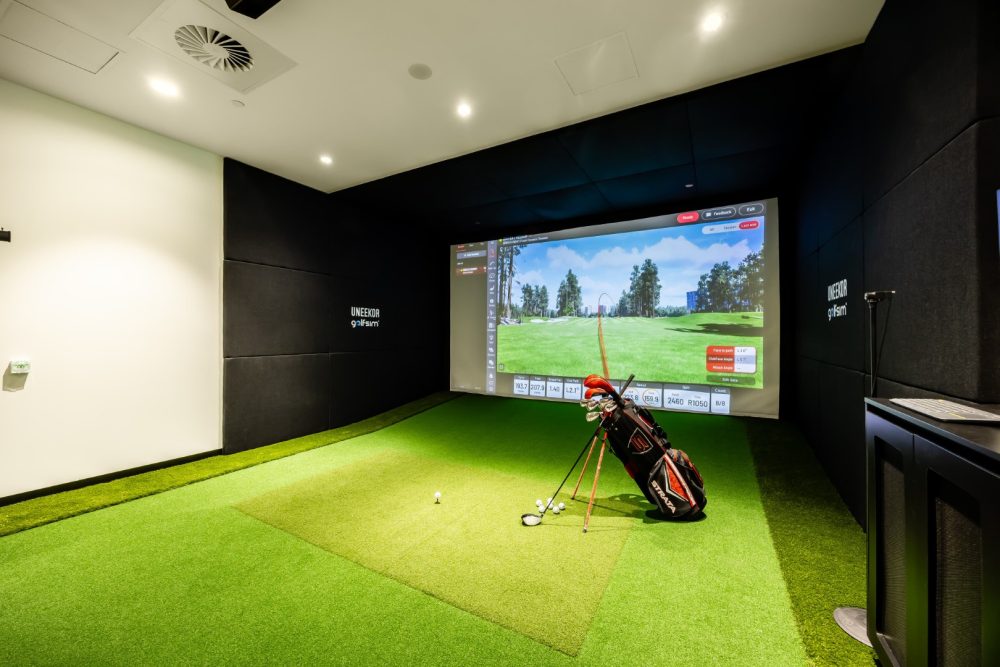
What counts as amenity has moved accordingly. The buildings that are securing tenants offer integrated cafes and restaurants that double as informal meeting space, end-of-trip facilities built to hotel standard rather than gym standard, fully functional gyms and yoga studios, bookable conferencing that saves a tenant leasing their own boardroom, concierge services, and increasingly the novelty items, whether that is a golf simulator, a wellness room or a rooftop terrace, that give someone a reason to suggest Thursday in the office rather than Thursday at home. None of that is frivolous. Each item is a small transfer of cost and effort from the occupier to the building, and collectively they change the maths an employer runs when deciding what space to take.
The Adelaide evidence
Adelaide has a clear worked example. 45 Pirie Street, an 18-level tower of roughly 19,000 square metres, completed a $20 million refurbishment delivering a Technogym-equipped gym, a yoga studio, a golf simulator, ensuite-style end-of-trip facilities described as the first of their kind in an Adelaide office tower, in-house catering, bookable meeting rooms, a concierge and a ground-floor wine bar and restaurant.
The tenant list that followed is the argument. Qantas, Bupa, Canaccord Genuity, Symal Group, Stellan Group and Holman Hodge, with an undisclosed tenant recently committing to three whole floors.
“45 Pirie Street is the clearest evidence in this city that amenity moves the needle. That building did not change its address, its floorplates or its structure. It changed what it offered the people who work there, and it attracted a tenant list that would not have looked at it in its previous form.”
Nick Shinnick, Managing Director, Upstream Property
“A $20 million spend on a building of that size is not a cosmetic decision,” Mr Shinnick said. “It is a repositioning, and the leasing outcome has justified it. The take away for owners is not that they need a golf simulator. It is that the tenant is now choosing a workplace, not a floor, and the building is part of what they are choosing.”
It is not only a CBD phenomenon
The assumption that this is a prime-grade CBD story is the most expensive mistake a suburban owner can make. Occupiers in the inner suburbs are running the same calculation, and in some cases the amenity case is stronger, because parking and end-of-trip provision are easier to deliver on a suburban site than in a CBD tower.
At 35-37 Stirling Street, Thebarton, a substantial refurbishment of a heritage-listed building attracted NHP Electrical Engineering Products, a national business that had the whole metropolitan market available to it. Heritage stock is often written off as unimprovable. Done properly, it delivers something new buildings cannot: character that an occupier can attach an identity to.
Nationally
The most instructive projects nationally are not new towers. They are old buildings that were kept. The common thread is that these owners did not treat an ageing building as a demolition problem. They treated it as an amenity problem.
Amenity is an operating discipline, not a capital event
Here is where a great deal of money gets wasted. Amenity is frequently approved as a capital project, delivered, photographed and then left to run itself. It does not run itself.
A gym nobody programs, a conference facility nobody manages and a ground-floor tenancy nobody curates become liabilities inside twelve months, and they become liabilities in the most visible parts of the building. The projects that hold their tenants are the ones where somebody is actively running the offer: managing bookings, programming events, maintaining the standard, and treating the occupier community as something to be built rather than merely housed. That work has a name in this industry, which is place-making, and it belongs in the management brief from the first day rather than being discovered in year two.
“Workplace functionality is a harmonious combination of high quality fitout and building amenity, and when you get both right you see something that never shows up in a rent review. You see knowledge transfer. Junior staff learn by proximity because senior people are actually in the room. You see company engagement lift, because people are choosing to be there rather than being told to be. That is what an employer is really buying, and it is why they will relocate for a building that helps them get it.”
Nick Shinnick, Managing Director, Upstream Property
What this means for owners who cannot spend Big Bucks
The worst available outcome for a secondary owner is a half-measure: enough capital spent to disturb the tenants and not enough to change the building’s position in the market.
The honest test is proportionality. Amenity spend should be scaled to the asset and to the occupier it is trying to attract, not copied from a tower five grades above it. A suburban office building does not need a golf simulator. It very likely does need showers and lockers that a cyclist would use twice a week, a lunch offer within a short walk, a meeting room the tenants can book, and a lobby that does not look like 1994.
Three questions are worth answering before any money is committed. First, who is the occupier this building can realistically win, and what do they actually complain about now. Second, what is the cheapest change that removes the top complaint. Third, who is going to run the amenity once it exists, and is that cost in the outgoings budget.
An owner who can answer those three has a repositioning strategy. An owner who cannot has a shopping list.
The flight to quality was always a slightly misleading description of this market, because it implied the winners were simply newer. They are not. They are the buildings that stopped selling floor space and started selling a reason to come to the office, and a considerable number of them were built decades ago.